
 English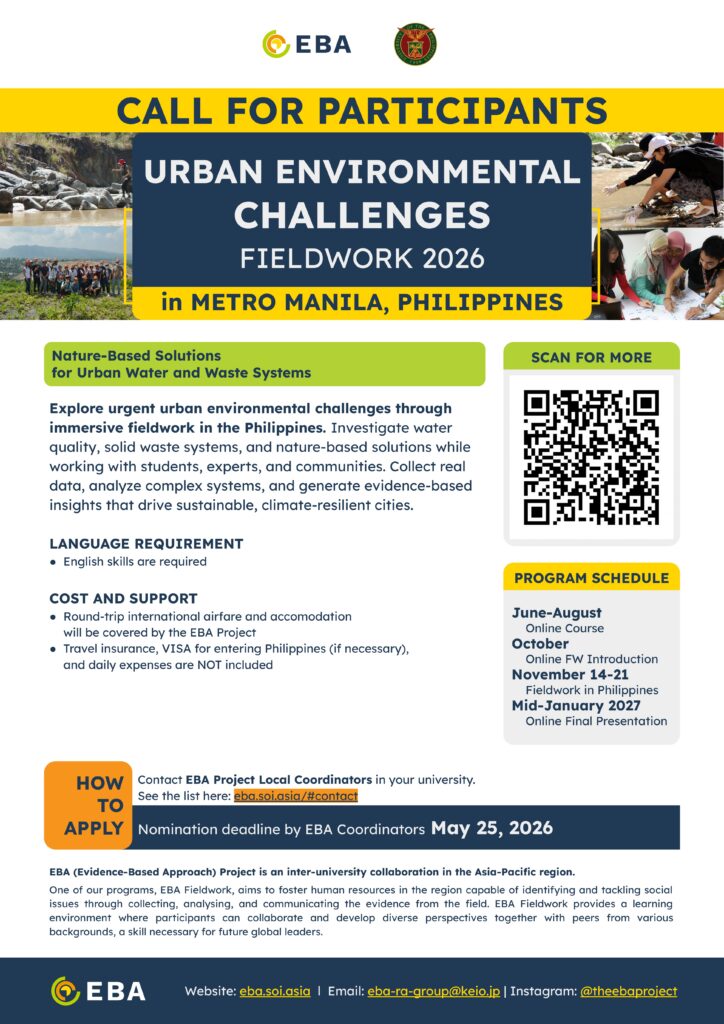
We are now calling for participants in the EBA-UPD (University of the Philippines Diliman) Fieldwork program in Quezon City, Philippines, for the year 2026: 14-21 November 2026 (7 days).
How do we generate evidence for solving urban environmental problems?
Urban pollution is often visible, but understanding its sources, pathways, and solutions requires more than observation. It requires data, systems thinking, and interdisciplinary collaboration. This fieldwork invites you to investigate how water pollution, solid waste systems, and treatment infrastructure interact in a rapidly urbanizing region, and how Nature-Based Solutions (NBS) can be integrated into these systems. Work with students, faculty, community, and other stakeholders to apply an evidence-based approach: collect data, analyze systems, and communicate insights that matter.
*Please note that the fieldwork may be rescheduled due to unexpected events.
About this EBA Fieldwork Program
EBA-UPD Fieldwork Program 2026 includes a workshop and fieldwork-related activities.
Urban Environmental Challenges: Nature-Based Solutions for Urban Water and Waste Systems
Theme: Environmental challenges in Asia and the Pacific: surface water quality degradation, solid waste management, and Nature-Based Solutions (NBS) for climate-resilient cities
This fieldwork aims to apply evidence-based approaches to:
● Understand the sources and impacts of urban pollution
● Examine how solid waste systems and water infrastructure influence environmental quality
● Explore how Nature-Based Solutions (NBS) can complement conventional systems
● Generate integrated, data-driven insights for improving urban resilience
The fieldwork will be conducted in Metro Manila and adjacent areas, a rapidly urbanizing region facing interconnected environmental challenges related to water pollution, solid waste management, and urban infrastructure. The program will be anchored at the University of the Philippines Diliman (Quezon City), the country’s premier national university, known for its expansive green campus and commitment to sustainability, providing an ideal setting for interdisciplinary learning and collaboration.
Key field sites include:
• University of the Philippines Diliman (Quezon City)
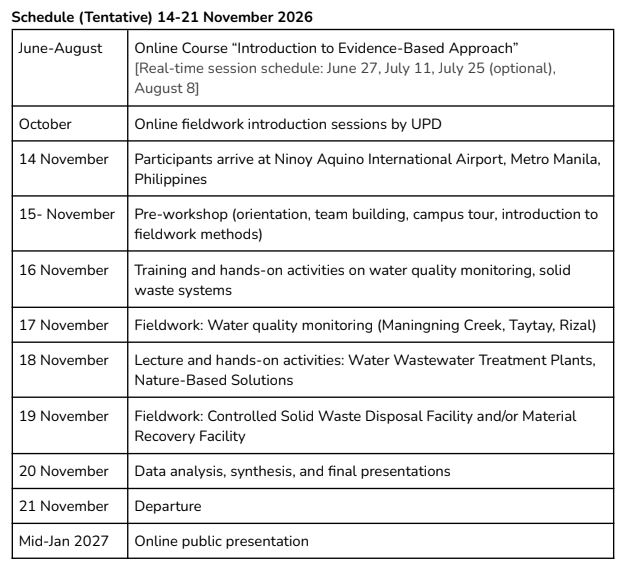
• Maningning Creek (Taytay, Rizal)
• Controlled Disposal Facility and community-based Materials Recovery Facilities In this fieldwork, participants will:
• Conduct water quality monitoring and environmental data collection in urban waterways
• Analyze solid waste management systems and their environmental impacts
• Understand water and wastewater treatment processes
• Identify and evaluate opportunities for Nature-Based Solutions
• Develop evidence-based insights and communicate findings through collaborative outputs
Language Requirement
All lectures will be provided in English. English skills are required; participants should be at least able to carry on conversations in English.
Online Introduction to Evidence-Based Approach Requirement
As indicated in the schedule below, participants must take the online Introduction to EBA course (real-time sessions, on-demand lectures, and project-based learning) prior to the fieldwork. Completion of the course is required to participate in the fieldwork.
Target and Capacity
This program is primarily designed for undergraduate students. However, graduate students are also eligible to apply.
● SOI Asia, EBA Project partner universities – 12 students
● UPD – 4 students
Prerequisites
There are no specific departmental or faculty prerequisites for students wishing to participate in this fieldwork. However, participants should have proficiency in using digital tools such as computers, smartphones, and similar devices, as these will be essential for documenting, collecting evidence, and conducting research.
*If many applicants apply for participation, screening (online interview) will be conducted in Q2, 2026.
Completion of the program
Participants will be considered as completing the program when they participate in all online sessions, fieldwork activities, and a public presentation. Upon completion of the program, participants will receive a certificate from the EBA Project.
How to Apply
You can apply via the link from today until May 15, 2026. (If there is more than one applicant, an interview will be conducted.)


